Home › Connectivity Beyond the Campus
Extending Secure Access into Public Locations
During COVID, the limitations of home connectivity became impossible to ignore. Some students simply did not have reliable internet access outside of school, regardless of device availability.
By this point, secure cellular connectivity was already proven on school buses. The architecture did not need to change. It only needed to be extended.
Solar-powered access units were deployed in public locations across the district. These units provided guest wireless access to students using district-issued devices. As with buses, cellular served only as transport. All traffic was tunneled back to centralized guest firewalls, where filtering and policy enforcement occurred.
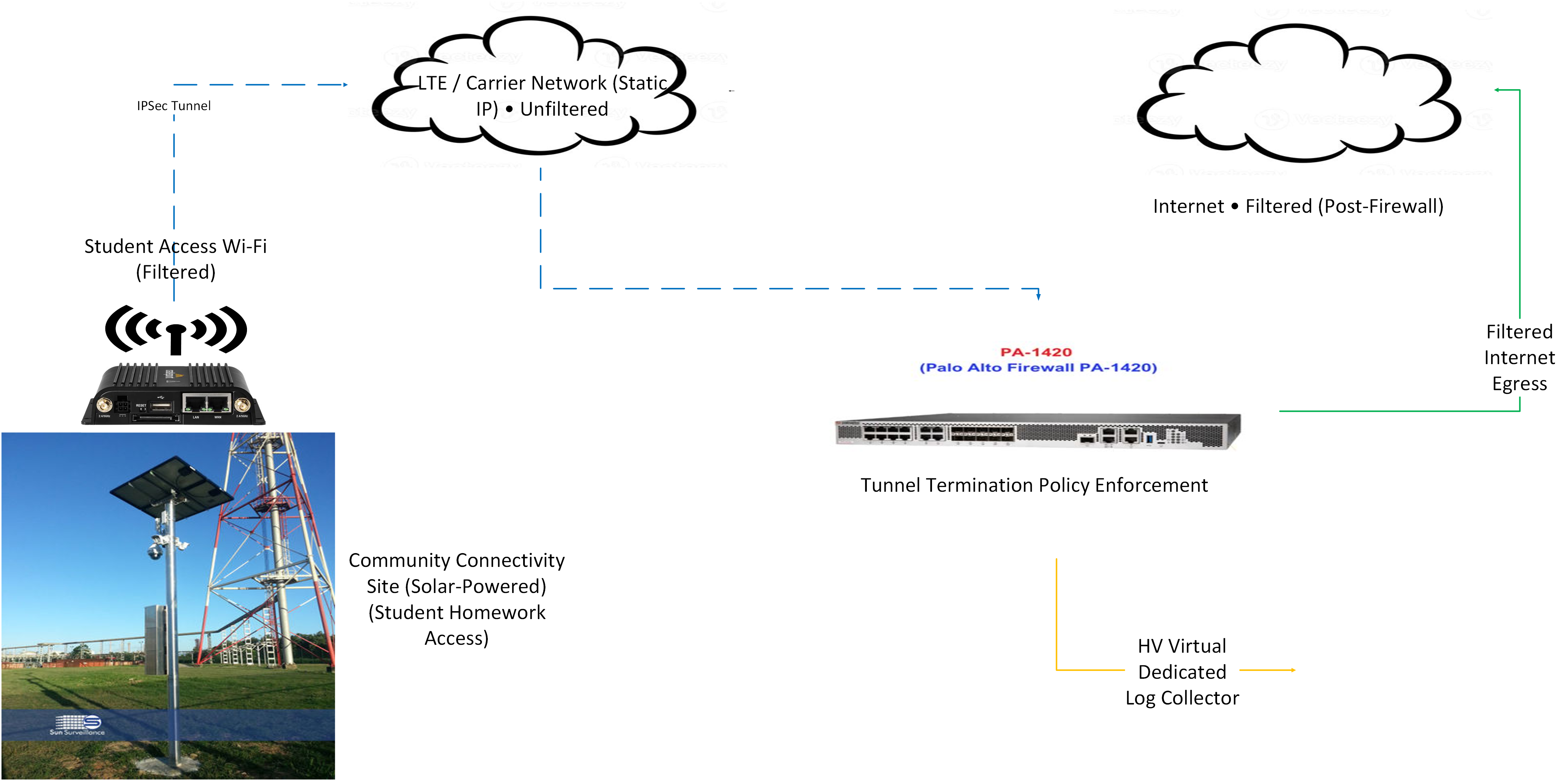
Click the diagram to open the full-size PDF.
No permanent construction was required. No new security model was introduced. Students experienced the same access they would receive on campus, and operations teams managed these deployments using the same tooling already in place.
This phase reinforced an important lesson: once policy enforcement is centralized, where users connect becomes far less important than how traffic is handled.